 Posted by

Is your PC running hot, loud, or slower than it should? This open hardware monitor download for pc guide shows you how to get a free hardware monitoring tool on Windows, set it up in a few minutes, and check your CPU temperature. Open Hardware Monitor shows live temperatures, fan speeds, voltages, and clock speeds for your processor, graphics card, and more. It is free, open source, and light on resources. Follow the steps below and you will see your PC’s vital signs today.
What Is Open Hardware Monitor?
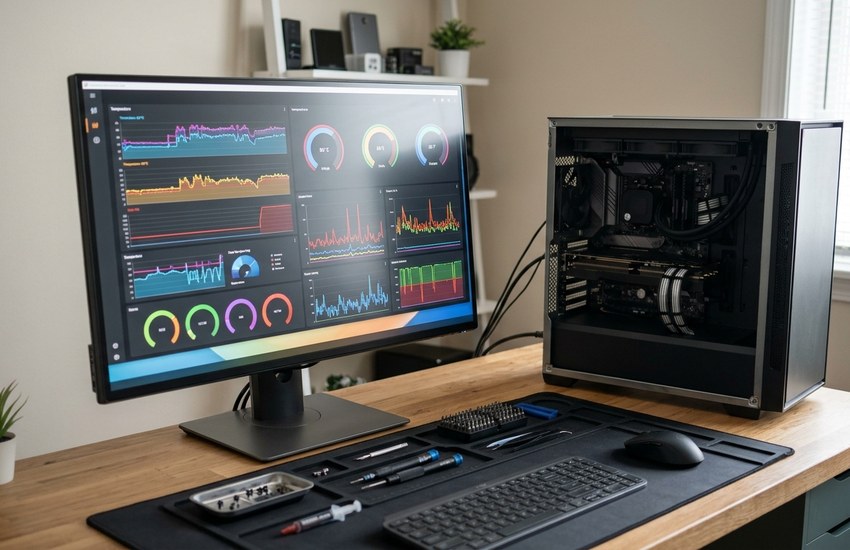
Open Hardware Monitor is a free, open-source application that monitors the temperature sensors, fan speeds, voltages, load, and clock speeds of your computer. It reads data from your motherboard, CPU, and graphics card and shows it all in one clear tree view. The program is portable, so there is nothing to install: you unzip it and run it.
It is popular with gamers, overclockers, and anyone troubleshooting a hot or noisy PC. You can watch your CPU temperature while gaming, check whether a fan is spinning, or log sensor readings over time to spot a cooling problem. It also displays values in the system tray and supports a gadget-style view, so you can keep an eye on temperatures without keeping the window open.
Key Features
- CPU temperature: live readings for each core of your processor.
- Fan speed monitoring: see how fast every detected fan is spinning.
- Voltage readings: check CPU, motherboard, and GPU voltages.
- Clock speeds: watch CPU and GPU frequencies in real time.
- GPU monitoring: temperatures and load for NVIDIA and AMD graphics cards.
- System tray display: show key sensors in the taskbar at a glance.
- Logging and plotting: record sensor data over time to spot trends.
System Requirements
- Operating system: Windows 11, Windows 10, Windows 8, or Windows 7
- Processor: any modern CPU with built-in temperature sensors
- RAM: 512 MB or more
- Storage: 10 MB free for the program files
- Software: Microsoft .NET Framework 4.7.2 or later (usually already on Windows 10/11)
- Internet: only needed to download Open Hardware Monitor
Open Hardware Monitor Download for PC: Official Method
Always get Open Hardware Monitor from the official source so you receive the genuine, untouched program. Follow these steps:
- Open your browser and go to the Download Open Hardware Monitor from the official website.
- On the official downloads page, find the latest stable release.
- Click the download link for the ZIP package (it ends in .zip).
- Save the ZIP file to your Downloads folder and wait for it to finish.
Avoid third-party download sites that bundle extra software. The official website above is the only source you need.
The whole open hardware monitor download for pc process usually takes only a minute or two on a normal broadband connection. The file is small, and once it is saved on your computer you can set it up whenever you are ready.
Open Hardware Monitor Download for PC: Step-by-Step Installation
- Open your Downloads folder and find the Open Hardware Monitor ZIP file.
- Right-click the ZIP file and choose Extract All.
- Pick a folder to extract to, for example C:\Tools\OpenHardwareMonitor, and click Extract.
- Open the extracted folder and find OpenHardwareMonitor.exe.
- Double-click the file to run it. There is no setup wizard because the program is portable.
- If Windows shows a security prompt, click Yes to allow it to run.
- Wait a few seconds while it reads your hardware sensors.
- For quick access later, right-click the .exe and choose Pin to taskbar or create a desktop shortcut.
How to Check Your CPU Temperature
Checking your CPU temperature is the most common use of Open Hardware Monitor, and it takes only a minute.
- Open Open Hardware Monitor from the folder you extracted it to.
- In the main window, find your processor under the Computer tree, usually listed by its model name.
- Expand the processor entry to see its sensors.
- Look for the Temperatures section. You will see a reading for each CPU core.
- Watch the Value column for the live temperature, and the Max column for the highest reading so far.
- To test under load, run a game or a demanding program and watch the numbers rise.
- For a normal idle CPU, expect roughly 30 to 50 degrees Celsius. Under heavy load, 70 to 85 degrees is normal for most processors.
- Right-click any sensor and choose Show in Tray to keep it visible in the taskbar.
If you have just completed the open hardware monitor download for pc and setup above, you can now check your CPU temperature whenever you like.
Open Hardware Monitor Download for PC: Is It Free?
Yes. Open Hardware Monitor is completely free and open source, released under the Mozilla Public License. There is no paid version, no trial, and no ads, so every feature is available to every user.
Frequently Asked Questions
Is Open Hardware Monitor safe to use?
Yes, when you download it from the official website. It is a well-known open-source project that only reads sensor data and changes nothing on your system.
Does Open Hardware Monitor work on Windows 11?
Yes. It runs on Windows 11 as well as Windows 10, 8, and 7, as long as .NET Framework is present.
Why does it need administrator rights?
Reading hardware sensors requires low-level access, so running it as administrator gives the most complete readings.
Can it monitor my graphics card temperature?
Yes. It shows GPU temperature, load, and fan speed for most NVIDIA and AMD graphics cards.
What is a safe CPU temperature?
Below 80 degrees Celsius under load is generally fine for most CPUs. Sustained readings above 90 degrees suggest a cooling problem worth checking.
Conclusion: Start Your Open Hardware Monitor Download for PC Today
Open Hardware Monitor is a small, free tool that answers a big question: is your PC running too hot? Follow the steps above, check your CPU temperature, and keep an eye on your fans and voltages to catch cooling problems early.
Related Guides
- Speccy for PC: How to Download & Install on Windows
- HWiNFO for PC: How to Download & Install on Windows