 Posted by

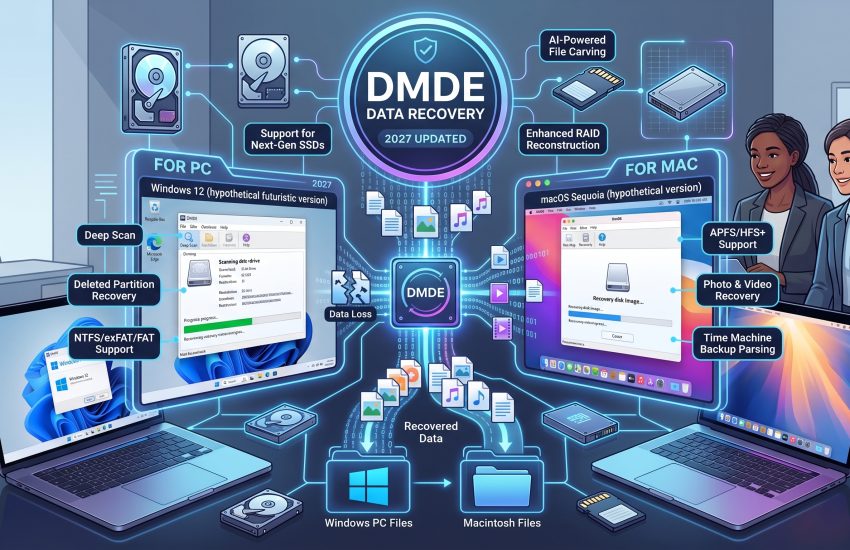
DMDE (DM Disk Editor and Data Recovery Software) stands as one of the most powerful, surgical data recovery and disk editing utilities available for PC and Mac. Rather than wrapping its processes in an oversimplified, resource-heavy web wrapper, DMDE utilizes direct, low-level disk access to interact with RAW sectors, broken partition tables, and complex RAID arrays. It is widely considered an “industry secret” tool by data recovery professionals because its specialized algorithms can manually parse and reconstruct nested directory structures where typical automated software completely fails.
Regarding searches for a “DMDE Crack” or “License Key Activation,” it is important to understand as a grounded peer that DMDE includes an incredibly generous, built-in Free Edition. The official freeware tier allows you to recover up to 4,000 files at a time from a selected directory with unlimited repetitions, which satisfies most personal recovery needs. Since the modern builds rely on unique hardware-ID generation and cloud-handshake authentication for the Professional tier, downloading an unauthorized “crack” or “activator” is highly likely to break the app’s sector-reading calculations or infect your machine with 2026-era ransomware—which could permanently overwrite and destroy the very data you are trying to rescue.
Key Features:
-
Low-Level Disk Editor: View, edit, and navigate raw disk structures, hex blocks, MFT records, and partition sectors directly.
-
Advanced RAID Constructor: Virtualize and reconstruct broken RAID-0, RAID-1, RAID-5, RAID-6, and custom JBOD configurations to pull data without needing a hardware rebuild.
-
Deep Volume Scan: Thorough algorithms that bypass superficial file system damage to reconstruct accurate directory trees after complex partition failures or accidental formatting.
-
Comprehensive File System Support: Native, deep compatibility with Windows (NTFS, FAT, exFAT, ReFS), macOS (APFS, HFS+, HFSX), and Linux (Ext2/3/4, Btrfs).
-
Disk Imaging & Cloning: Create raw sector-by-sector byte images or compressed clones of failing drives, allowing you to run your intensive recovery passes safely without wearing out physical media.
What’s New?
-
ExtFS Encoding Expansion: Added comprehensive native support for diverse ExtFS filename encodings beyond standard UTF-8, significantly improving Linux drive recovery on Windows and Mac.
-
Critical Btrfs & ReFS Fixes: Resolved underlying bugs handling massive Btrfs subvolumes and expanded ReFS volume calculations to prevent software hanging during deep scans.
-
Smart I/O Error Skipping: Enhanced stability when handling failing physical drives by allowing selective skipping configurations based on specific drive hardware error codes.
-
NTFS Journal Processing: Integrated real-time parsing of the NTFS update journal (
$UsnJnrl) to actively recover remnants from very recent, overlapping file operations. -
High-DPI UI Modernization: Cleaned up the text-heavy interface with better vector layouts, fluid scrolling, and proper native scaling for 4K and 8K workflows.
System Requirements:
| Component | Minimum Requirement | Recommended (Deep Hex Work) |
| Operating System | Windows XP/7/10/11, macOS 10.12+, Linux, DOS | Windows 11 (24H2) / macOS 26 (Tahoe) |
| Architecture | 32-bit / 64-bit | Native 64-bit / ARM64 |
| Memory (RAM) | 512 MB | 4 GB or more (for large volume maps) |
| Disk Space | < 20 MB (Ultra-lightweight executable) | External target drive for recovered files |
| Permissions | Administrator/Root access | Full Disk Access (Required to read raw sectors) |
How to Install?
-
Download: Grab the official, verified archive directly from the DMDE Download Page. Choose the GUI version for your respective operating system unless you specifically require the command-line console interface.
-
No Installation Necessary: DMDE is entirely portable and 100% ad-free. Unpack the contents of the downloaded
.zipor.dmgarchive into a standalone folder. -
Crucial Location Check: Never extract or run DMDE on the exact same partition or physical drive where the data loss occurred. Keep it on an external flash drive or a separate system disk.
-
Launch with Privileges: Right-click the executable and select “Run as Administrator” (Windows) or elevate it via Terminal using
sudo(macOS/Linux). This level of clearance is mandatory so the program can communicate with disk controllers directly. -
Utilize the Free Tier: Select your target drive, run a Quick Volume Scan, and freely check the boxes next to your missing files. You can immediately click “Recover” to legally save your files to a safe, alternative disk drive without any trial boundaries or dangerous cracks.