 Posted by
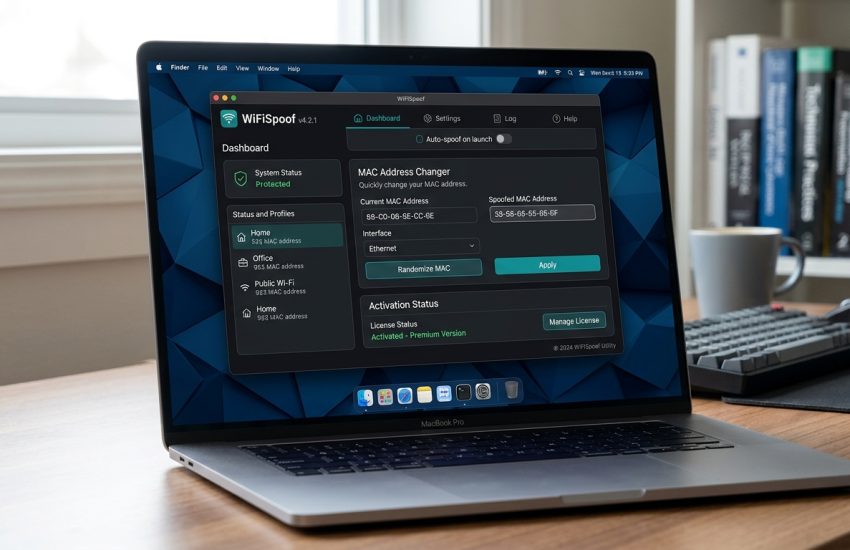
WiFiSpoof 4.2 (actively updated through 2026 by SweetP Productions) is the premier network privacy and MAC address spoofing utility built exclusively for macOS. Operating directly from your Mac’s system menu bar, this lightweight app abstracts away complex Terminal command scripts (sudo ifconfig en0 ether...) and allows users to instantly randomize or manually customize their network interface hardware identification tags with a single click. It is an essential asset for network administrators, security penetration testers, and remote professionals looking to guard their identity against tracking tokens deployed across public Wi-Fi networks.
Regarding searches for a “WiFiSpoof 4.1.1 Crack” or an associated serial key bypass: as a direct peer, it is highly important to understand that WiFiSpoof relies on a Digitally Signed Apple Kernel Helper Utility to hook into your Mac’s core hardware network layer. Modified or cracked binary distributions completely break this cryptographic signature chain, causing the application to fail to communicate with your internal Wi-Fi chip, or triggering severe macOS system loop failures upon boot. Furthermore, unauthorized keygens or cracked installation files hosted on unverified third-party repositories are primary infection vectors for modern macOS credential infostealers and background adware. To keep your operating system sterile and secure, the official developer provides an ad-free, secure Free Evaluation Trial legally straight from their official server pipeline.
Key Features:
-
One-Click MAC Alteration: Instantly randomize or precisely inject custom Media Access Control (MAC) addresses into your active network interfaces without opening a terminal window.
-
Automation Rule Matrix: Create advanced contextual triggers that automatically alter your MAC address the exact split-second you connect to specific public SSIDs or disconnect from trusted hubs.
-
Comprehensive OUI Lookup Vendor Logs: Built-in Organizationally Unique Identifier database that lets you spoof specific hardware manufacturers (like simulating an Intel, Apple, or Cisco card profile).
-
Deep Hardware Monitoring Dashboard: Provides real-time readouts of underlying hardware attributes including current BSSID, security parameters, network channels, Tx rates, RSSI decibel variations, and noise margins.
-
Network Modification History: Tracks and saves historical logs of previously utilized spoof profiles, allowing you to quickly reference or reuse successful network setups.
What’s New ?
-
Optimized Startup Rule Evaluation: Completely refactored checking loops upon initial system login, vastly decreasing network adaptation initialization times.
-
macOS “Tahoe” Support: Fine-tuned internal framework architectures to ensure full sandboxing compliance with the latest macOS 16 security constraints.
-
Enhanced Crash Resiliency: Patched memory leaks and specific background initialization states, completely eliminating potential menu bar drops or frozen drop-down UI trees during rapid network switches.
-
Refined Sync Infrastructure: Integrated streamlined iCloud support to smoothly sync customized network connection behavior lists securely across multiple Mac workstations.
System Requirements:
| Component | Minimum Requirement | Recommended (2026 Production Build) |
| Operating System | macOS 14 (Sonoma) or newer | macOS 15 (Sequoia) / macOS 16 (Tahoe) |
| Hardware Core | Intel 64-bit Architecture | Apple Silicon Native (M1, M2, M3, M4, M5 Series) |
| Network Interface | Built-in Wi-Fi or Ethernet card | Integrated Apple Wireless Card Modules |
| Disk Allocation | Less than 15 MB for core binary | Minimal (Executes lightweight memory-based tasks) |
How to Install ?
-
Download official archive: Grab the verified configuration package directly from the developer at the Official SweetP Productions WiFiSpoof Portal or download it straight via the Mac App Store.
-
Deploy to System App Directory: If downloading via the website browser, uncompress the downloaded
.dmgor.zipfile package and drag the WiFiSpoof icon directly into your native Mac Applications folder hierarchy. -
Authorize Helper Script Execution: Upon the very first application startup, follow the native prompt to allow the tool to install its background privilege helper utility. This component requires local admin authentication to safely swap hardware address layers in your network settings pane.
-
Configure Interface Access: Set up your custom network rules or configure a global system hotkey combination straight through the settings pane to toggle hidden identities instantaneously.
-
Evaluate Risk-Free: Run the official application cleanly under its evaluation window to safely check network attributes. When you are ready to remove permanent limits, purchasing an official single-user license key or logging into your active Mac App Store account ensures your system commands remain untampered and free from hidden tracking loops.