 Posted by

AVG Secure VPN (actively maintained by Gen Digital and integrated into its unified v26.x production suite layout for Windows) is a performance-focused virtual private network application. Built on transparent, widely vetted networking protocols like OpenVPN and Mimic (an advanced obfuscation protocol designed to slip past anti-VPN firewalls), the software encapsulates outbound system traffic using bank-grade 256-bit AES encryption. It includes dedicated streaming and torrenting server channels, a programmatic kill switch, and automated public Wi-Fi protection routines to preserve your digital privacy.
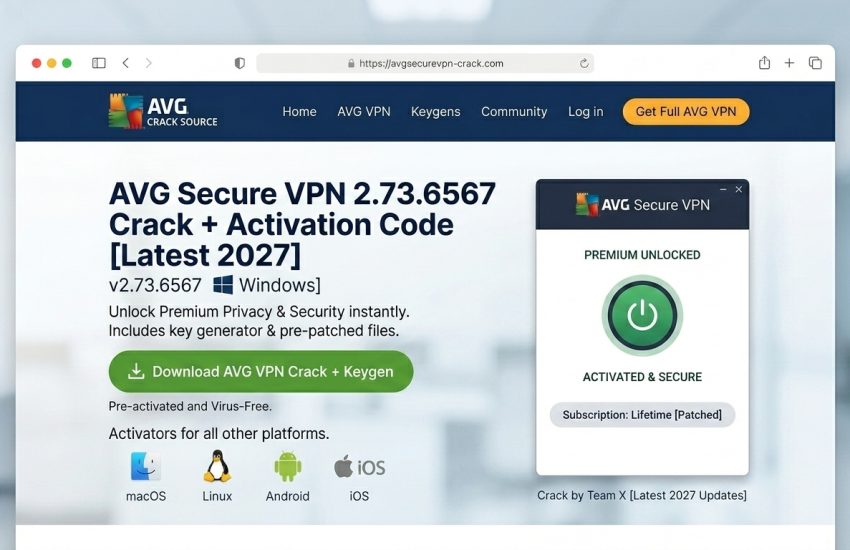
Regarding widespread third-party links, peer-to-peer torrent indexers, and warez forums indexing “AVG Secure VPN 2.73.6567 Crack + Activation Code [Latest 2027]”: it is critical to call out the technical, structural, and severe safety realities behind these entries. The version sequence v2.73.6567 is completely fabricated. Real PC client packages sync smoothly with the vendor’s overarching v26.x runtime environment. Pirate software syndicates manipulate version structures paired with words like “Premium Crack” or “2027 Activation Code” purely to trick search engines and trap users into executing harmful scripts.
Because a core privacy engine must request elevated system administrative privileges to mount virtual network adapters, tap directly into the Windows network stack via low-level kernel drivers, and dynamically rewrite global routing tables, executing an unverified “crack tool” completely compromises your workstation’s native security boundaries.
Because a VPN client sits directly between your device and the open internet, running a cracked binary grants absolute traffic and credential visibility to an external threat actor. These tampered setups serve as major distribution channels for automated corporate credential infostealers, network-sniffing backdoor trojans, and destructive background ransomware. Bad actors can use a modified network client to perform Man-in-the-Middle (MitM) data captures, recording your unencrypted website keystrokes, siphoning active browser session tokens, or even utilizing your private residential bandwidth as a blind relay node for illicit botnet traffic. Sourcing pristine, untouched application binaries directly from the vendor’s secure infrastructure ensures 100% data safety, perfect system hygiene, and maximum connection speeds.
Core Mechanics :
-
The Custom Mimic Obfuscation Protocol: Disguises secure VPN data packets to look like ordinary, non-encrypted HTTP/HTTPS web browsing traffic, allowing connections to pass smoothly through restrictive corporate firewalls or regional censorship blocks.
-
Open-Source OpenVPN Core: Relies natively on highly transparent, widely vetted industry-standard protocol layers combined with OpenSSL to handle encryption matrices rather than relying on unverified proprietary scripts.
-
Collective Shared IP Masking: Blends your outbound network presence into a pool of active users sharing the exact same virtual IP address block, preventing external algorithms from mapping or isolating your traffic habits.
-
Dedicated High-Bandwidth Profiles: Features a optimized selection of servers tailored explicitly to process peer-to-peer (P2P) file transfers and low-latency multimedia streams without local speed throttling bottlenecks.
-
Comprehensive Leak Remediation: Deploys a programmatic global kill switch framework that freezes all outgoing data streams instantly if your network interface drops its secure link, actively eliminating accidental raw IP data leaks.
Modern Workstation Hardening & Licensing Realities:
-
Strict Core Isolation Compliance: The official virtual network adapter miniport drivers carry valid Microsoft WHQL digital signature verification markers, enabling them to execute flawlessly alongside advanced security protections like Hypervisor-Protected Code Integrity (HVCI).
-
Live Server-Side Account Handshakes: Premium subscription tier validation (which unlocks over 100 global server locations and multi-device connection configurations for up to 10 machines) runs exclusively via real-time encrypted database checkups on AVG’s live authentication servers using a synchronized AVG Account login. Because local system variables cannot fool the remote validation node check, third-party key generators act strictly as malware delivery wrappers.
System Requirements:
| Component | Minimum Technical Specification | Recommended Workstation Standard |
| Operating System | Windows 10 (Build 22H2 Core Layout) | Windows 11 / macOS / Android / iOS (64-bit) |
| Network Interface | Virtual TUN/TAP Miniport Driver Insertion | Fully Compliant Secure Boot Environment |
| Processor (CPU) | Intel / AMD Dual-Core 1.5 GHz | Modern Multi-Core Processing Architecture |
| Memory (RAM) | 1 GB Baseline System Memory | 2 GB RAM or higher (Speeds up cryptographic parsing) |
| Storage Allocation | ~50 MB for core installation binaries | Minimal local footprint (Maintains an ultra-lean workspace) |
How to Setup ?
To configure, deploy, and route your internet traffic through a pristine, premium VPN tunnel without exposing your credentials or falling victim to malware deployment schemes, utilize the standard official deployment routine: