 Posted by

QuarkXPress (actively running on its major v22.x internal build engine, commercially known as QuarkXPress 2026) stands as one of the most long-standing, powerful desktop publishing (DTP) and graphic design environments globally. Purpose-built for professional typographers, print publishers, and digital media designers, it provides a highly reliable, vector-precise alternative to Adobe InDesign. It enables creators to map complex multi-page layouts—such as commercial magazines, annual corporate reports, catalogs, and interactive eBooks—natively on local drives without forcing permanent cloud-only storage subscriptions.
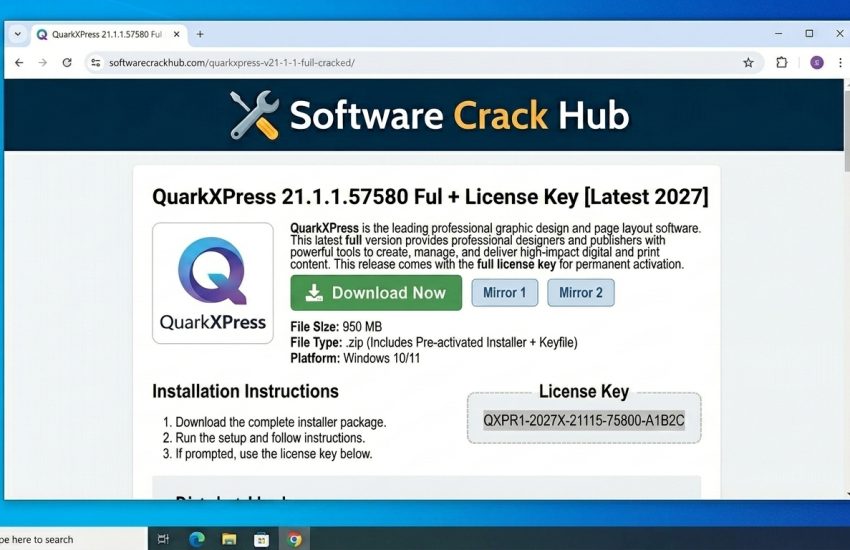
Regarding online search traffic targeting a “QuarkXPress 21.1.1.57580 Full Crack + License Key”: as a fellow designer navigating desktop publishing deployments, it is important to understand the actual version structure. The version string v21.1.1 corresponds specifically to a legacy maintenance build from the mid-2025 QuarkXPress 2025 release pipeline. Third-party download channels advertising a “2027 Updated Crack Loader” for it are using old build markers as bait to drop highly destructive, silent malware payloads onto your system. Because high-end publishing suites require deep root filesystem interaction to cache font libraries, manage local image links, and write system postscript files, executing an unverified “pre-activated patch” or registration keygen completely strips away your operating system’s default security parameters. These unverified downloads are notorious vehicles for automated credential infostealers, browser session hijackers, and system-level ransomware that can instantly compromise your active client projects. To keep your studio workstation sterile and protected, the official developer distributes an entirely legal Free Trial Version directly from their content delivery networks.
Key Features:
-
Vector Precision Layout Engineering: Create complex, multi-page document trees using advanced grid alignment systems, explicit layer management, and precise vector shape nesting properties.
-
Advanced Typography & Slider Controls: Complete, native integration for Variable Fonts, allowing layout artists to smoothly adjust font weight, widening properties, slant angles, and tracking parameters via intuitive sliders out of a single file.
-
Integrated Multi-Language Font Manager: Includes a robust, built-in font collection handling palette, allowing users to activate or deactivate massive typography libraries on the fly to keep the system memory clean without requiring third-party plugins.
-
Seamless IDML Packaging Interoperability: Effortlessly import and export InDesign Markup Language (
.idml) packages complete with structural tables, style sheets, callouts, and static asset mapping for fluid cross-platform team collaboration. -
Direct Local Image Recognition: Leverages specialized image analysis to instantly scan, categorize, and index massive local photographic libraries, letting designers search for assets using simple visual keywords.
What’s New?
-
Built-in LaTeX & MathML Support: Introduces native formatting engines for complex mathematical and academic notations, allowing STEM textbook publishers to write and edit editable formulas directly on the layout canvas without third-party mathematical plugins.
-
The “Paste Into” Asset Positioning: Overhauls graphical framing, enabling designers to instantly drop uncompressed images or grouped vector elements straight into customizable geometric container shapes with zero distortion.
-
Dynamic Paper Color Contrast Simulation: Features a modernized background simulator panel that mimics the physical tone and texture of real-world print paper choices, allowing operators to verify visual contrast ratios before committing to production.
-
Redesigned Workspace Launcher: A fully overhauled Welcome Screen featuring customizable dashboard configurations, immediate presets for target document margins, and instant access to localized project histories.
System Requirements:
| Component | Windows Workstation Baseline | macOS Workspace Specification |
| Operating System | Windows 10 (64-bit) / Windows 11 | macOS 14 (Sonoma) / macOS 15 / macOS 16 (Tahoe) |
| Processor (CPU) | Intel / AMD Multi-Core 2.5 GHz or higher | Apple Silicon Native (M1–M5) or Intel Core i7+ |
| Memory (RAM) | 4 GB Baseline System Memory | 8 GB RAM or higher (Crucial for multi-page catalogs) |
| Storage Space | ~3 GB available local disk target | SSD partition space for high-speed scratch caching |
| Display Layout | 1280 x 1024 Resolution Minimum | Retina Canvas Optimized with crisp high-DPI scaling |
How to Install?
-
Retrieve Official Deployment Packages: Skip risky third-party hosting mirrors. Download the completely clean, untouched installation setup executable or native Apple disk image directly from The Official QuarkXPress Installer Downloads Portal.
-
Run the Setup Wizard: Launch the setup routine (
QuarkXPress_2026.exeor mount the Mac.dmgwrapper file). The installation process runs 100% clean and ad-free, containing zero bundled junkware or hidden performance utilities. -
Establish Interface Preferences: Open QuarkXPress. On the newly redesigned Welcome Screen, choose your default workspace orientation or select from standard preset target aspect ratios (A4, Letter, custom brochure folds).
-
Calibrate Font Libraries: Access the Font Manager palette to let the software automatically index your local typography files and Google Font paths for instant structural pairing.
-
Utilize the Official Trial Mode: Run your design comps, vector text wraps, and color simulation arrays safely under the official trial framework. Activating your publishing environment through legitimate channels guarantees total file protection and print-ready format validation, completely shielding your creative workstation from the severe cybersecurity threats tied to unverified software cracks.